.png?width=345&height=139&name=PORT%20LOGO%20TEAL%20w%20LIFESAVER%20(2).png "PORT Lighting")
Share this
by PORT on Dec 11, 2025 3:07:29 PM

Stage curtains that are behind on cleaning, treatments, or need to be replaced not only give a bad visual for your stage, but also pose a severe fire hazard. To avoid this, it is important to be aware of when your curtains need an update, and what that update actually consists of.
In this guide, we'll go through how to determine the age of your curtains and what kind of upgrades are needed (or not needed), depending on that and the NFPA 701 rating. As leaders in theatrical installations, we know the impact stage curtains have on a show.
The History of Stage Curtain Fabric
Historically, the good Theater curtains were a rich, deep, piled Silk Velvet that had a nice surface sheen, draped well in pleats and swags, and the ability to eat light. Cotton Velour fabrics were introduced to mimic that richness at a lower cost point. These Non Flame Retardant (NFR) fabrics were treated by an immersion process to make them Flame Retardant (FR).
Most theaters in operation today will have or have had Cotton FR Curtains in their inventory. Modern textile design has allowed us to achieve the same look and feel using Inherently Flame Retardant (IFR) materials (typically, a blend of polyester fibers).
NFPA Fabric Classifications
The National Fire Protection Association (NFPA) has established rules for fabrics and how to classify their ability to resist flame (NFPA 701). Flame Retardant (FR) fabrics are treated through an immersion or surface coating to allow them to resist burning. The efficacy of this treatment will reduce over time. Inherently Flame Retardant (IFR) fabrics are noncombustible for the life of the fabric.
These fabrics still need to be kept clean to avoid the buildup of flammable materials on their surfaces. An occasional vacuuming with a brush head (not the beaters!) will remove surface dust and sawdust particles that can burn. Since these fabrics have a nap to them, it is recommended to start at the top and work down
How Do I Know What My Curtains Are Made Of?
Easy! Each curtain SHOULD have a tag stating the manufacturer's or installer's name, construction dates, and fabric type, size, and NFPA 701 rating (NFR, FR, or IFR). This tag may be easily accessible at one of the side or bottom hems of the curtain, up high on one side, or attached to the webbing at the top, depending on the manufacturer. Most of the cotton curtains will have a brown, scratchy jute webbing across the top, which the fabric is sewn to.
This webbing supports the stitching pleats, hanging grommets, and adds structure to the top of the curtain. These curtains may also have a small scrap of the curtain fabric stitched to a hem or seam that will allow the fire marshal access to the curtain fabric for testing without destroying the curtain. Most of the newer IFR curtains will have a black webbing along the top made of a synthetic material to maintain the IFR rating.
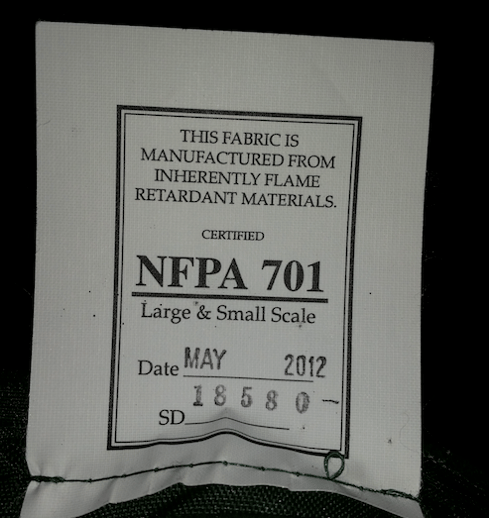
My Curtains Don't Have Tags! How do I know What Their NFPA Rating Is Now?
This may take a little bit of detective work to figure out. See if the financial office has a record of the last time they were replaced, or check with facilities to see if they have the original specifications from when that part of the building was constructed. However, if it was THAT long ago, this is your opportunity to replace/upgrade them and get IFR curtains installed!

What Do I Need To Do To Maintain My NFPA 701 Rating?
- IFR curtains: need to be cleaned occasionally; frequency is based on exposure to dust and flammable particles.
- FR curtains: need to be tested and retreated every 3-5 years (depending on exposure and environmental conditions). If they do not pass testing, they can be re-treated on site using a surface saturation solution sprayed on from the back, or sent out for cleaning and immersion treatment. A general rule is that they can be re-treated 3 or 4 times and then should be replaced (roughly every 20 years).
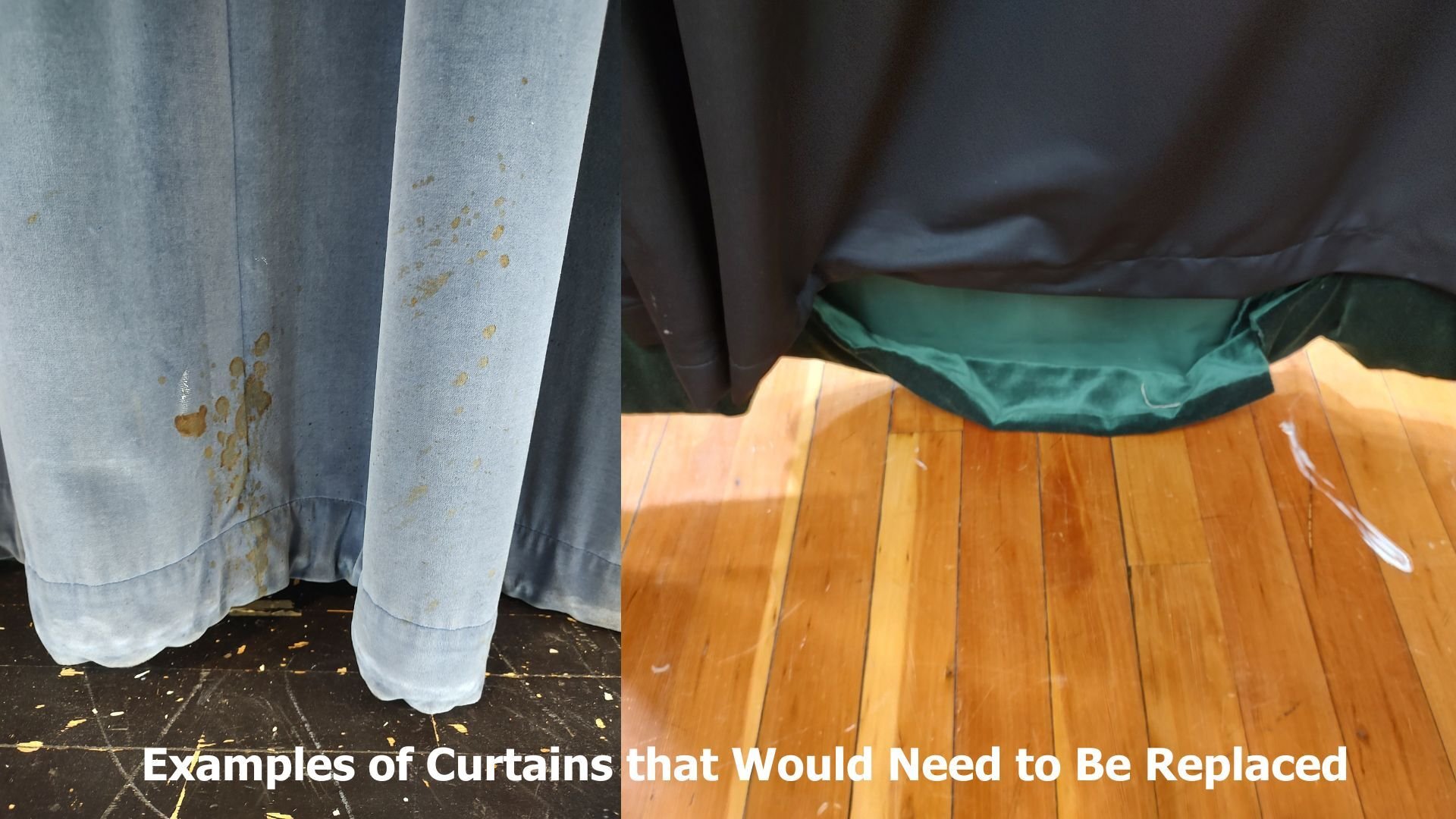
My Curtains Are Ripped, Smell Bad, and Look Like They Have Salt Stains Climbing the Fabric- What Do I Do?
Unfortunately, there is not much you can do to save the curtains at this point. This is pretty standard for older cotton curtains that have not been cleaned or re-treated in years, or ever. The cotton fabric starts to dry rot, and the fire-retardant additives start to fall out of solution. This is your opportunity to replace and upgrade to IFR curtains. Once you install the IFR stage curtains, expect them to last 30-50 years.
My Local Fire Marshal Said That My Curtains Failed Their Inspection - What Do I Do?
Fire marshals will look for the visible tags that SHOULD be there, and then will request your documentation and certificates. If they don't find the information they need, they may do a small-scale field test using a sample of the fabric and a match. Generally, they are looking for the fabric to self-extinguish in under 2 seconds, and for any sample falling to the floor not to smolder.
This method is not as reliable as a lab test, but it will roughly indicate the ability of the sampled fabric to resist flame. Depending on the age and condition of the curtains, you may be able to get them re-treated, OR this is your opportunity to upgrade and install IFR curtains. Make sure your new curtains have visible tags, and that you keep their certificates on file for review.
Let PORT Make Sure the Show Goes On Safely
At PORT, we put safety first always. Reach out today, and see how our stage curtain installation services can keep your stage from being a fire hazard. Our team at PORT is always happy to help.
Other services we provide:
No Comments Yet
Let us know what you think